There’s nothing more frustrating than coming home on a hot day to find your home feeling unusually hot. You check the thermostat, which is still set to cool, and suddenly wonder, “Why is my AC blowing warm air?”
Fortunately, there are plenty of common reasons that your air conditioner is blowing warm air. Most can be checked in a few minutes, but some may require a technician’s expertise.
In this guide, we’ll cover all the most common causes and fixes, including thermostat problems, air filters, power capabilities, the outdoor unit, refrigerant, and frozen coils.
Keep reading to learn more, and get your home cool and comfortable again.
Start Here: Quick Things to Check First
To answer the question, “Why is my AC blowing warm air?” you can start with a few quick, no-tool checks around the house.
- Confirm the thermostat is set to cool and not heat or fan-only.
- Lower the set temperature a few degrees.
- Check that the unit doesn’t have a dirty air filter.
- Make sure vents are open and not blocked by furniture.
If you’re feeling extra handy and want to keep investigating why your AC is blowing warm air, understanding how your cooling system works will help. For more on how air conditioning units cool your home, check out the DOE home cooling guide before continuing.
Thermostat Settings Are the Most Common Reason
Now, let’s dive deeper into each potential cause, the first being thermostat settings.
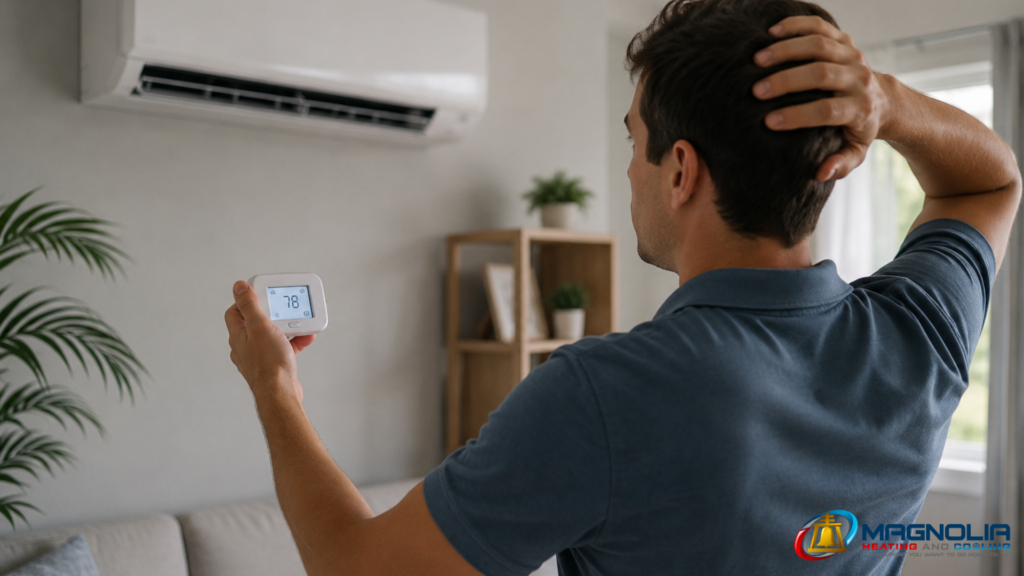
All thermostats, old and new, typically have three standard settings: heat, cool, and fan. When only the fan is on, it pushes room-temperature air even when the AC is not actively cooling.
So, when you feel the warmer air filling your home, check the thermostat settings first to see if the notch got knocked from “cool” to “fan” or what mode it’s showing as active.
Often, when AC is blowing hot air, it’s because the thermostat is in the wrong mode or the batteries are dead.
If the thermostat indicates a low or dead battery, that is likely the culprit. Weak battery connections can prevent the thermostat from properly communicating with the HVAC system or triggering a cooling cycle. Replace the batteries, and reset the thermostat settings to cool.
When a thermostat is only set to “fan,” it isn’t telling the outdoor unit to start its cooling cycle. Switch it to cool, then check the vents again. Then set the fan to Auto rather than On so it runs only during an active cooling cycle.
Need AC repair fast? Call Magnolia today.
A Dirty Air Filter Chokes Airflow
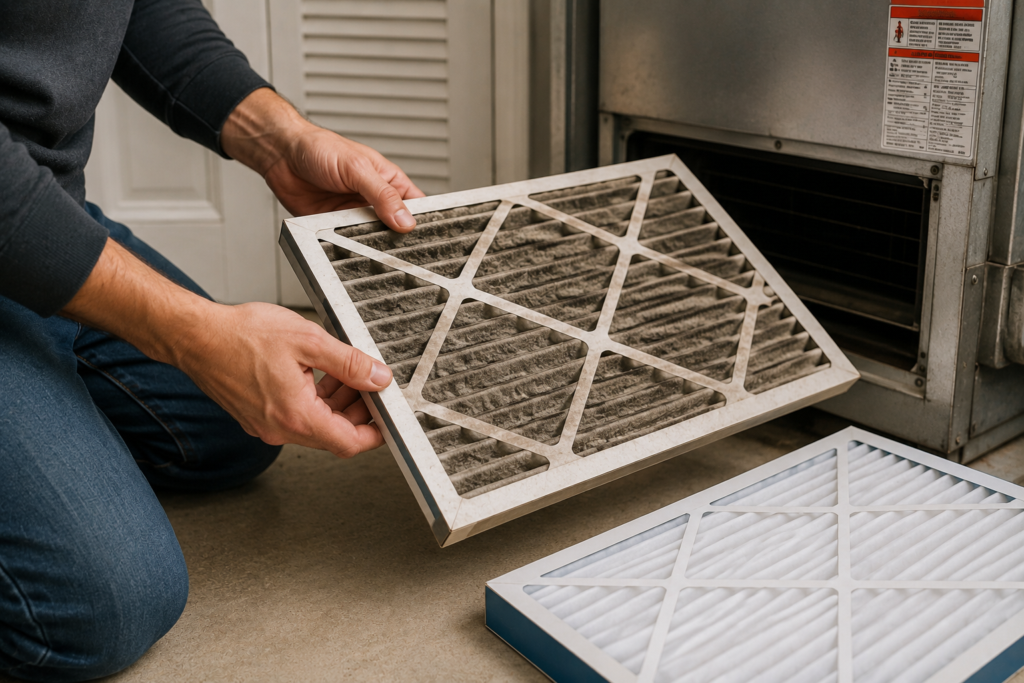
Another common cause of AC blowing hot air is a dirty air filter. If your furnace’s air filter is dirty or clogged, it can restrict airflow. This weakens cooling and can even lead to further issues.
Without cold air flowing, it can cause a frozen evaporator coil, which will further limit the system’s ability to cool the home.
Check your home’s air filter at least once a month, and change it every 1-3 months depending on how dirty it is. You’ll know it’s time to change it if the filter is—
- Gray
- Dusty
- Visibly coated with debris
And if you can’t see the filter’s material beneath the buildup, it’s definitely time to change it. This is one of the fastest, easiest, and most cost-effective fixes a homeowner can do to fix an air conditioner blowing warm air.
To stay up on furnace and AC unit maintenance, use the ENERGY STAR maintenance checklist to guide you.
The Outdoor Unit Lost Power or Is Dirty
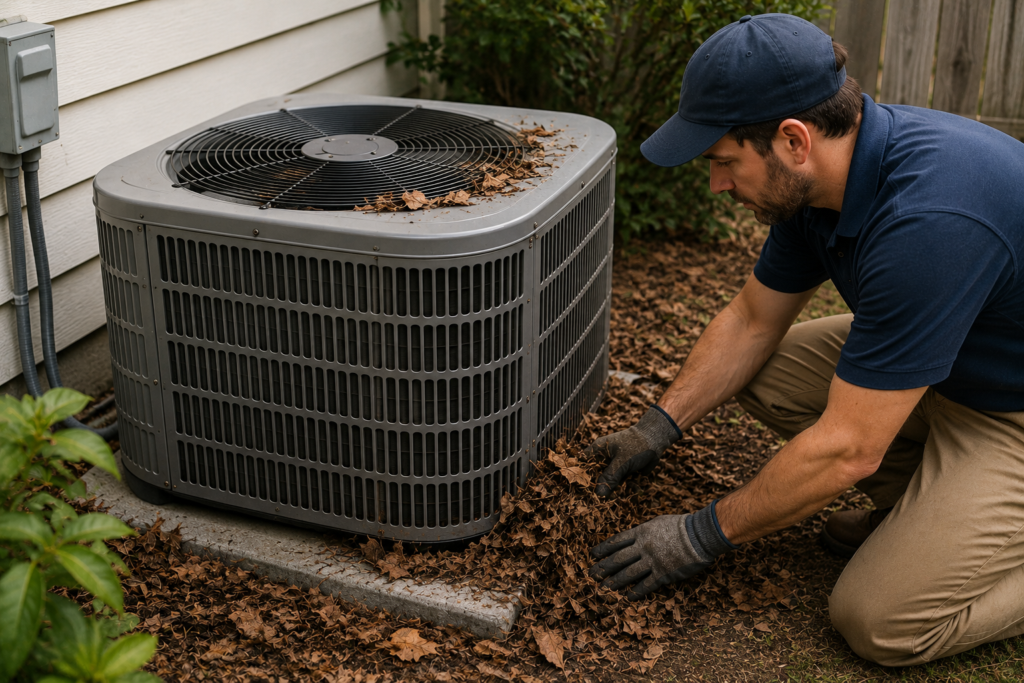
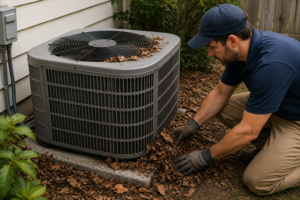
The next common cause of AC units blowing warm air is issues with the outdoor unit. In many cases, a dirty condenser coil or unkempt outdoor unit can be the cause of the AC not cooling correctly.
The most common reasons for the outdoor unit to be malfunctioning or not turning on are power issues, like a tripped breaker or flipped outdoor disconnect. Or, a dirty condenser coil that could be clogged with dirt, leaves, glass clippings, or other outdoor debris.
To troubleshoot, start by removing any leaves, weeds, or loose debris from around the unit and condenser. Being sure that the system is turned off, you can gently rinse the coil.
Avoid using a power washer that could bend or damage the delicate condenser, and use a garden hose to carefully remove surface dirt.
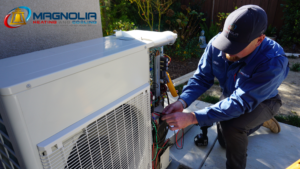
Proceed with caution if all signs point to an electrical problem. Start by checking the breaker to see if the unit has tripped it, but avoid opening electrical panels or touching wiring, capacitors, or other components inside the outdoor unit.
If the breaker continues to trip or the condenser still won’t turn on, it’s best to call in an HVAC professional to investigate further.
Low Refrigerant or a Refrigerant Leak
Your AC could be blowing hot or warm air because of a refrigerant leak or low refrigerant levels. Refrigerant is a substance that travels through the AC system, absorbs heat from inside the home, and carries it outdoors where it can be released.
When refrigerant levels are low, the system cannot absorb and transfer heat as effectively, so the air coming from the vents may feel warm. Low levels may also cause the evaporator coil to get too cold or freeze, which can further restrict airflow and cooling.
Typically, refrigerant doesn’t get used up and needs replenishing. So if this is the source of the problem, there’s likely a leak somewhere inside the unit that needs to be addressed.
Unfortunately, unlike dirty air filters or thermostat settings, this isn’t a DIY fix, but luckily many contractors can make a same-day AC repair. Handling refrigerant requires a licensed HVAC technician, as do leak detection, repair, and system recharging.
AC not cooling? Call Magnolia for same-day diagnostics and repairs in the Inland Empire.
[(951) 688-3524] [Contact] [Schedule Appointment]
A Frozen Evaporator Coil
As we’ve mentioned a few times, a frozen evaporator coil can also be a common cause of your AC blowing hot air. As you know, restricted airflow from a dirty filter or low refrigerant can freeze the evaporator coil.
To work properly, the evaporator coil requires a steady flow of warm indoor air passing over it. When factors like a dirty filter or low refrigerant are present, they restrict airflow or reduce pressure in the system, causing the evaporator to cool or freeze.
If ice builds up on the coil, it blocks the refrigerant from transferring heat to the indoor air. It also prevents the coil from absorbing heat efficiently, which can further restrict airflow through the system.
When you have a frozen evaporator coil, the first step is to turn off the system and let it thaw. Then, call upon a professional to diagnose and address the underlying cause so the issue doesn’t happen again.
Failing Capacitor, Compressor, or Blower Motor
A failing capacitor, compressor, or blower motor are three components that can also be the source of air conditioners blowing warm air.
The three parts work together, with the capacitor helping the compressor and blower start and run. The compressor ensures the refrigerant is circulating and allowing the system to move heat, and the blower motor moves the cooled air through the house’s ductwork.
If any of the three weaken or stop working, the system will stop moving cool air. Homeowners should express caution when opening up equipment panels to check any of these parts themselves, as it’s not a DIY fix.
If your AC is blowing warm air and you hear unusual humming, clicking, or grinding, or notice the system struggling to start or move air, call an HVAC technician to inspect it for repair or potential replacement if it’s a failing compressor, which often indicates a new system is necessary.
Protect your system year-round. Learn about our Maintenance Plans.
DIY Fixes vs. When to Call an HVAC Technician
Now that you know more reasons why your AC is blowing warm air, it’s crucial to know which issues are eligible for DIY fixes and which require an HVAC technician.
| DIY Fixes | When to Call an HVAC Technician |
|---|---|
| • Thermostat settings: Check the thermostat to ensure the right mode is selected, the fan is set to Auto, and the temperature is set appropriately. • Dirty air filter: Swap out any dirty or clogged filter to restore proper airflow. • Check the breaker: Resetting a tripped AC breaker is simple, but if it trips again, call a technician. • Clear outdoor units: Homeowners can easily remove leaves, weeds, dirt, and grass clippings from around the condenser. • Thaw a frozen coil: To thaw a frozen coil, simply turn off the AC and let the ice melt completely before restarting the system. | • Refrigerant issues: Refrigerant requires special handling, so an experienced tech will need to locate and repair any leaks. • Electrical problems: Wiring, capacitors, contactors, and other electrical components are best handled by trained professionals. • Compressor issues: Compressor problems also require specialized testing, tools, and repair experience. • Evaporator coil freezing: If the evaporator coil is continually freezing after thawing, an underlying refrigerant, airflow, or mechanical problem may be causing it, requiring professional diagnosis. |
Keep in mind that regular tune-ups like those offered with HVAC maintenance plans can help prevent dirty filters, frozen coils, and other issues in the first place.
Get Fast AC Repair From Magnolia Heating & Cooling
If you’re in the Inland Empire and wondering, “Why is my AC blowing warm air?” call upon the area’s most trusted team: Magnolia HVAC. Magnolia has proudly served Riverside and San Bernardino County with exemplary service since 1951.
We’ll get your home cool and comfortable again with same-day service when available, all $75 diagnostic fees are waived with repairs, and extra peace of mind from a 12-month guarantee on all work.
Check out our current specials or get in touch to schedule an inspection with our experienced local team.
- Note same-day service when possible, a $75 diagnostic fee waived with repair, and a 12-month guarantee on all repairs.
- Keep the sell warm and low pressure.
- End with the end-page CTA buttons.
- Internal link: next to the diagnostic-fee and guarantee mention, add the “current service specials” anchor pointing to .
[(951) 688-3524] [Contact] [Schedule Appointment]
Frequently Asked Questions
- Why is my AC blowing warm air but running?
Your AC could be blowing warm air but still running because of thermostat settings, a dirty air filter, loss of power to the outdoor condenser, dirty condenser coils, frozen evaporator coils, or low refrigerant. Start with simple fixes like the thermostat, filter, or breaker before calling for service.
- Can a dirty air filter cause my AC to blow warm air?
Yes, a dirty air filter can cause your AC to blow warm air. If an air filter is dirty or clogged, it can restrict airflow, reducing the system’s ability to cool, or cause other issues like a frozen evaporator coil, which can also cause the system to run but blow warmer air.
- How do I know if my AC is low on refrigerant?
You’ll know your AC is low on refrigerant if it’s blowing warm air, running longer cycles, struggling to reach the thermostat setting, or causing unusually high energy bills. Other signs include ice or frost on the refrigerant lines or evaporator coil, or any hissing or bubbling sounds. Refrigerant is part of a closed system, so low refrigerant generally indicates a leak rather than something that is simply “used up.” An HVAC professional should handle leak diagnosis and refrigerant work.
- Why is my AC blowing warm air only at night or during the hottest part of the day?
Your AC may be blowing warm air only at night most likely due to thermostat scheduling or programmed temperatures that are set incorrectly. If your AC is blowing warm air only during the hottest part of the day, it’s likely undersized, aging, dirty, or poorly maintained. Intermittent warm air can also be related to a frozen coil, dirty condenser, airflow restriction, or equipment that is overheating and shutting down temporarily, so if a pattern is tied to a particular time of day, an HVAC technician can help narrow down the cause.
- How much does AC repair cost in the Inland Empire?
AC repair costs in the Inland Empire vary greatly depending on the failed component, system type and age, labor, refrigerant needs, parts availability, and whether emergency/after-hours service is required. Many common AC repairs fall around $150–$850, with diagnostic service calls ranging from $75–$250.